
On Dutch case
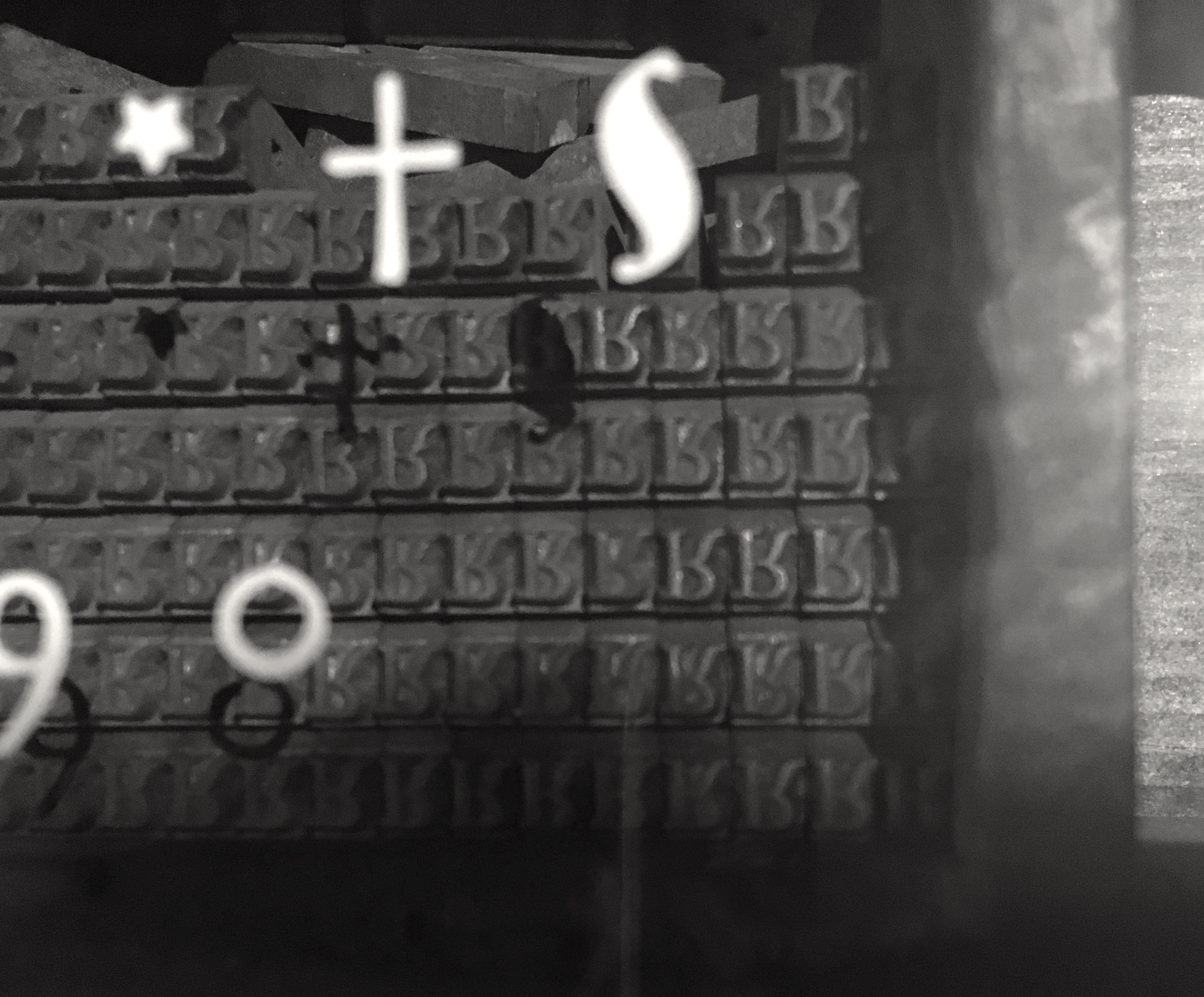
The Realist typeface derives its name from the quiet magnificence of the XVI century called Reale Romain. It is fully presented in metal and print species in the Plantin-Moretus Museum and available through the Library Catalog. The referenced item is the flemish spring of the High French Renaissance. This is from cut of Hendrik van den Keere, whose talent may not be overlooked — neither by his contemporaries nor by designers of our age.
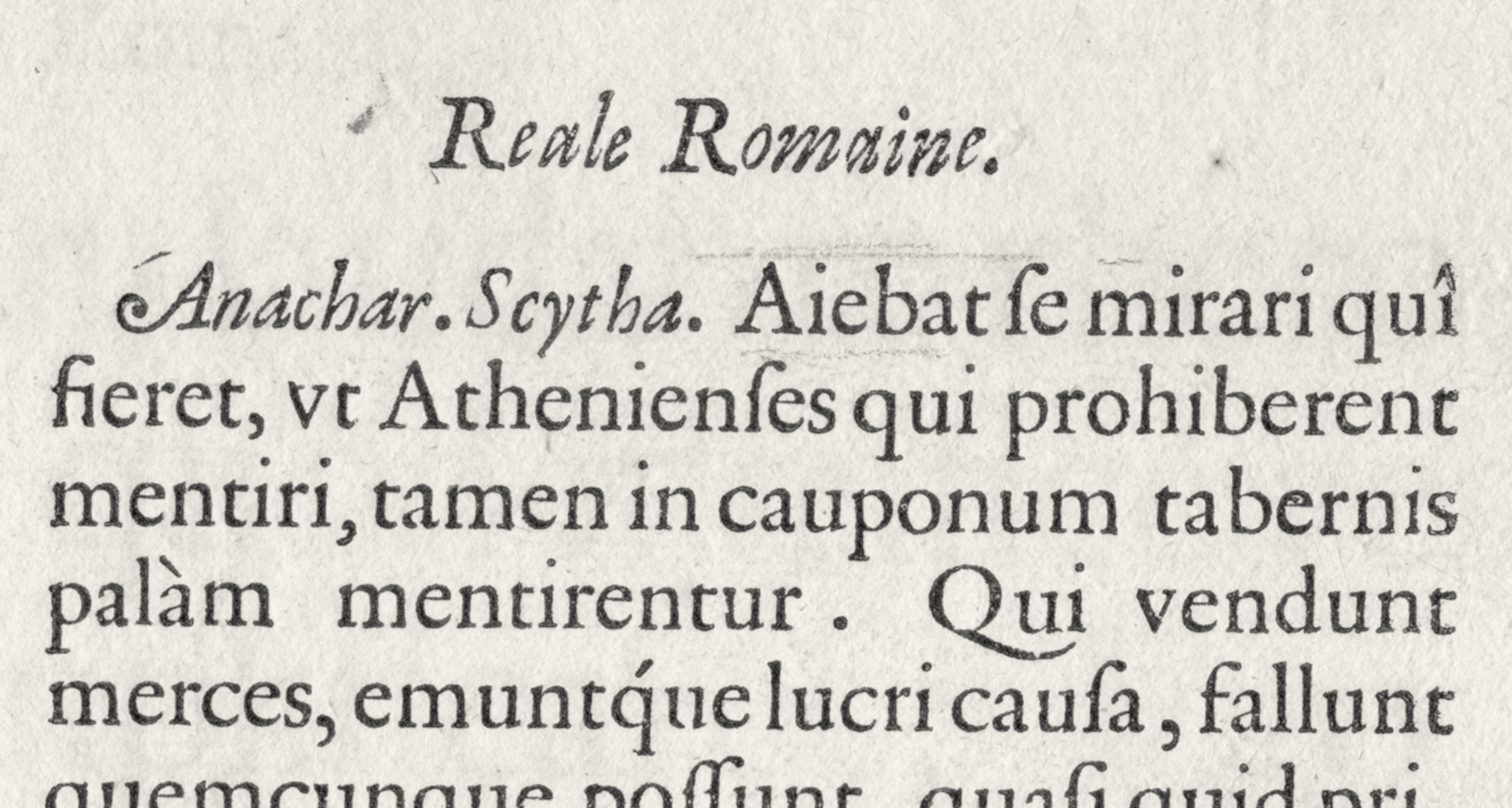 'Reale Romain' or 'Parangonne Romaine' of Hendrik van den Keere
and how it originally appeared in Christofer Plantin's so known 'Index Characterum', 1576.
Henri du Tour, as he presented himself on french manière, is the provider of the roman (and thus far Parisian) channel onward to the Lower Lands. His life was quite short but gave us the perl typefaces and concepts that are still fundamental for modern typography. He is a typographer of the second generation and represents the second wave of Roman tradition in Flanders. His father acquired the print house of Joos Lambrecht — the pioneer and one of the most brave and experimental typographers in history. This fact gives us a hint toward imagining the personality of Hendrik van den Keere too: his being in an accumulating several layers of culture from different worldviews and traditions. He was a sole supplier of type for Christoffel Plantijn for several period, there he took some rework jobs on his major contemporaries like Claude Garamond and Robert Granjon. — Is any better school can be imagined?
By and large, the presented project of OFF combines two most precious works of Hendrik van den Keere: Reale Romain and Double Pica Roman. That might be straightforwardly stated in Realist as: the upper part is the Reale, and the lower part is the Pica. But they are quite different although! The first, Reale Romain is splendid idea of the new human of the Renaissance; the other, Double Pica Roman, is national and personal — residual medievalism and the pragmatics of 'hard work' of Protestant criticism.
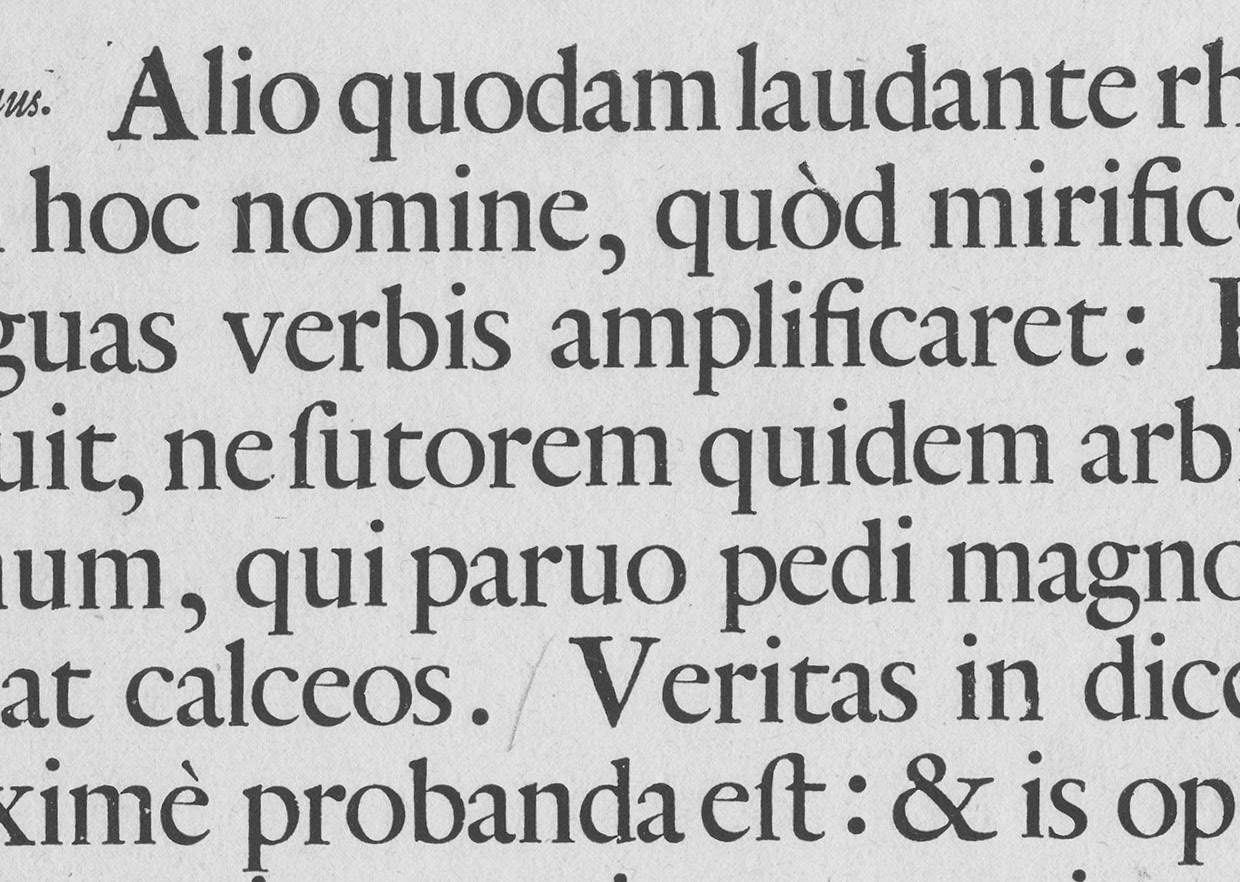 Just next to the real-roman in the same Specimen of Plantin we see the other treasure of Hendrik Van den Keere: Two-Line Double Pica roman type, 1573.
The name 'flamandes' for blackletter shows up the obvious strong gothic tribe in Flanders. And the story of how the new roman letters of Joos Lambrecht were rejected by a dutch reader was resolved by Hendrik Van den Keere.
Through his typecasting activities for Plantin, van den Keere became thoroughly familiar with the French styles, and in consequence his own work derives from both schools. In his romans he combines the sophisticated French forms with something of the economical proportions and sturdy weight relationships of his familiar Flemish blackletter. These romans, introduced in Holland through Plantin's Leyden office, appear to have been the first in the family of strong, economical, 'Dutch'-style romans that reached international importance in the seventeenth century with the work of Christoffel van Dijck, Willem Janszoon Blaeu, the Voskens, Nicholas Kis, and their school — and ended in the eighteenth century with the work of William Caslon and his imitators in England.
We can with no doubt call Hendrik Van den Keere the father of what we call 'dutch taste'. All that we love in the Dutch is well presented in his oeuvre and well explains what the Dutch taste is. The value of this 'taste' may be found in all later periods of history. The 'dutch taste' according to Mr. Morison was a core sense for his Times. We do find the combination of high human idea and pragmatism, evenness and solidity — the resolving key to the demands of our post-modern times too.
Realist itself
The Realist project emerged as the continuation of years spent with the Plantin Museum archives and its neighbourhood. It is fully influenced by letter-model theory of Professor F. E. Blokland described on the source letter-model.org. The theory of the Professor was the significant part of evolving own considerations and workflow.
— Rhythm is the dancer —
Defining the rhythm of a font — the repeating of all
those simple inner lines — is what makes the very font, master and Epoch.
— Pixelisation and moiré productivity —
A simple way to define the
generalisation of letter shapes and define the Rhythm.
— Grouping of letters —
Despite the calligraphic coherence, groups of letters has different personages from master to master and gains the own Rhythm Section of the master.
— The personal style of metal-cutting —
It gives a main hint towards the shape definition.
— The mass of the imprint gives the dynamic base for the metaphor. —
Some Giacometti sculpturing must appears.
— Metaphor and mass teach each other. —
The personal style of cutting of Van den Keere was distilled from the sources assigned above, but the general plastic idea of the Font came from one special imprint from the Allard Pierson Library from Amsterdam. There, in fact, the bottom part of the letters held a little more ink. That effect grew into the idea to perform the incoming of roman fonts into the Lower Lands as the combining the Double Pica and Reale Romain of VdK.
In this case we see a certain catching effect — the stem became slightly trapezoidal, which gives a more synonymous shape to the anatomy of the inclined bowls of the Renaissance font. (This is more fully represented in the Granjon classics, which are also on the way to appearing from OFF.)
On problem of realism
applied to font production
with translation to worldview
Our Van den Keere project gathers the personal artistic style and the conceptual timeless treasure of flemishes. His other roman style letters such as Coronelle Romain should be noticed, as well as his blackletter (which by the way surpass even Fleischmann) and his musician types. But the attempt to copy — to only keep and share the joy of some witnessed miracle — always runs into the problem of realism, which is another reason to name the project as such.
Realism is always a reconstruction, finding the live core, human in it: the idea and the resurrection of it with a renewed body and materials in the right new world. This is how to provide the uniting line through all history — to find the idea, its logic, and the personal artistic discoveries of a certain master — meeting a new Other.
In our age, when such words as post-humanism have appeared, and even the most contemporary AI models use serif to bear words — it would be good, and in the most meaningful and healthy sense, to remember the consistency of Humanism itself and then resurrect its ideas in their better form. This is how Realist derives its contour. With Fra-Angelico and Giotto seen in closed eyes — and yes, with the book Rubens drawings on top of one's lap and remembrance of material printing. In its result, and despite its direct historicity, the Realist font is extremely new and actual.
On Renaissance, it's fonts and worldview
The general idea of the Renaissance, its central admiration and joy — the mind amazed by this simple invention: all humans belong to Someone Who, being in all ways a human (except any missorder, sin), did more than any human ever can — Who even conquers death, Who had a Word to the World to be and it came into being. So that is why the elder greek dream of human as the meusure of things got resurected new quality.
This admiration in noble pace of a Renaissance font and it rests on two key principles: air and rhythm. This comes partly from one another — partly derived from the principles well described by Professor F. E. Blokland, and partly from the restrictions of font production of those times. In any case the font of the Renaissance illustrates well the man of its time — with his enlightenment, his awareness of the great news of humanity: the heavenly is now partaker of the earthly.
There is an important and interesting general idea of Renaissance typefaces that comes from Their apparent similarity. They are similar, and a trained eye is required to distinguish one master’s hand from another at a glance. Even such fathers as H. D. L. Vervliet, when describing one or another set of matrices, resort to a simplified way of marking distinguishing constructive elements (a 'single-serifed', 'dog eared', and so on) to name the font — whereas Professor Blokland, rightly and brightly identifies rhythm as the primary formative and meaningful property of type.
Indeed, they are similar — but this especial fact reveals to us a great and partly inaccessible now and remarkable activity: all the type designers were making one font. Is this not also a lesson for us, since EcTd classes, — to let Word to connect us — defining the Rhythm, rather than distinguishing and multiplying self-glorifying alternatives?
And this is how Realist reveals one general principle of Renaissance fonts — it is not another serif that differs, but it is drawn to be The Font: the only shape for the Word.
And such an amusing and contradictory effect — Realist became complementary to almost any font pairing. It fits naturally with any heavy or regular Swiss, with distinctive experimentalist or fancy aczidentials. It is so elastic that to create a relative italic was another huuuuge (as Professor Blokland says) challenge. That task is successful and is coming out as the Poet typeface project. You can pre-order the Poet — a probable italic-fitting of Realist (but also a self-sufficient font) — following this link.
Realist for OFF
The concept of the quiet, calm pearl gives a major principle to the OFF foundry. Look at Van den Keere — he is not so outstanding as Granjon, not so representative as the Estienne cutters, not as extremely functional as Haultin, nor as blustery as his predecessor Lambrecht — but we return to him again and again.
This is what we want to avoid. The font here as the warmth of a mother's hands. As that we see in a Vermeer canvas. Let us remember that one pouring milk from a jar — how calm, restful and reassuring that seeing is.
Because kindness and gentleness are stronger than arrogance and envy. This is victory without a fight — a familiar and fundamental aspiration for everyone.
On floating and NFT
Right from that point of the 'personal' — through ages and ages, seeking need to meet one human with another — came the idea of NFT-personalised sale. It reveals the resale component and the personal snippet of the 'matrices' of the font — exactly as it happened in plantinian times, when one printer simply asked the punch-cutter to pour him some of those beautiful letters, and while transferring through punch-matrices-print they became more unique.
On St. Paul and Augustin
The idea of the non-constant, moving contour lies on the surface and has been known since the earliest computer experiments. This only confirms the obvious value of non-constancy as the positive value in the perception of type — and the continuity of this approach through epochs and medias.
This way, we see in Realist an anthropomorphic approach to the variability of the contour: it is the accumulation and systematisation of the facts of life during their formation — and their subsequent unification. It is the refusal of a straight-forward answer — but also the acceptance of it as a possibility and a hope for a system of a more complex and general conclusion: about time and memory.